


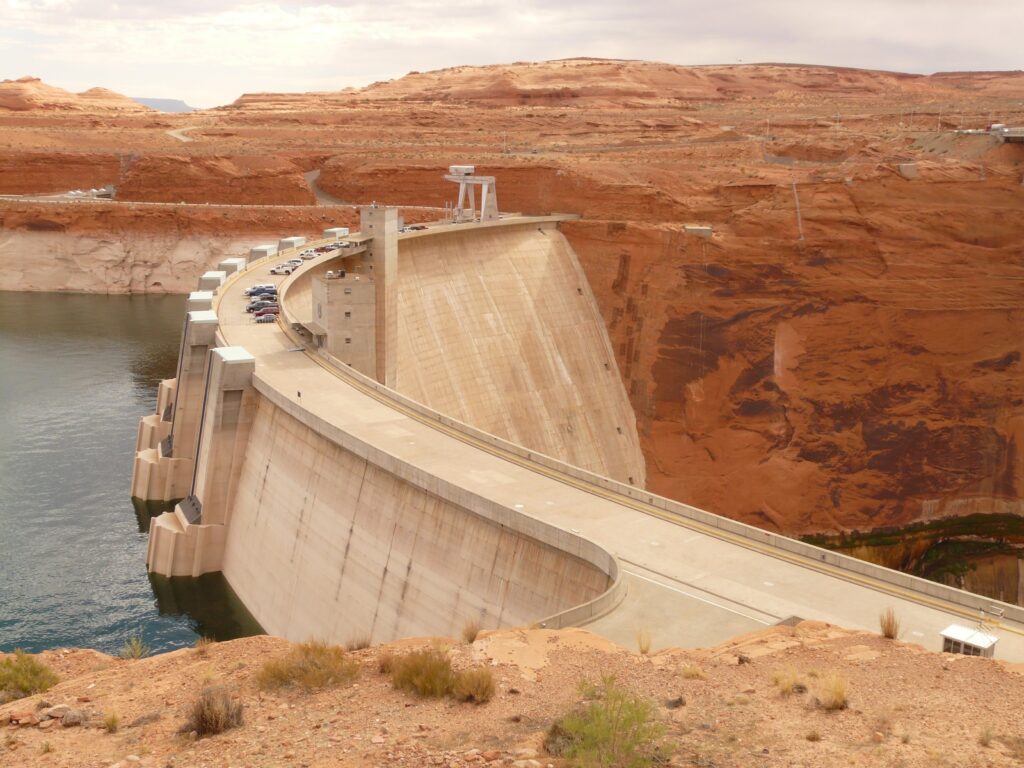
Spain leads the European rankings with a total of 1,064 dams, infrastructures that have been the engine of the country’s development and well-being over the last century. However, Spanish geography now faces a silent threat: the ageing of these structures. With many dams already exceeding 50 years of service, we are approaching the limit of their estimated useful life, which ranges between 50 and 100 years depending on concrete quality and environmental conditions.
At TECAFIL, we understand that the importance of these works lies in their multifunctionality: drinking water supply, irrigation, hydroelectric power, and flood control. Nevertheless, the combination of old concrete with «new» surface repairs creates a critical engineering challenge. To guarantee safety, it is imperative to evolve from traditional patching toward molecular restructuring, a technology that unifies the concrete mass and definitively halts structural deterioration.
Water Dam: Stability and Pressure Management
A water dam is a living organism that must constantly balance its own weight against the massive hydrostatic pressure of the reservoir. Ageing typically manifests in submerged areas, where pressure facilitates moisture penetration into the concrete matrix, causing carbonation and internal weakening. By applying TECAFIL NANO QUIMIC AP technology, we enable nanoparticles to penetrate deeply, transforming the concrete into a hydrophobic barrier that blocks water passage at a molecular level.
This restructuring technique is the only one that offers a lasting solution compared to traditional systems, which often fail due to a lack of adhesion under back-pressure. By converting the concrete’s pores and capillaries into an insoluble crystalline network of calcium silicate, we ensure the dam regains its original watertightness. This proactive approach is key to extending the lifespan of our water infrastructures and protecting the communities that depend on them.
Structure: Thermal Challenges and Molecular Integrity
The structure of a dam is subjected to mechanical fatigue due to the constant expansion and contraction caused by temperature changes. This factor, combined with aging, generates micro-cracks that compromise overall stability. Using TECAFIL’s nanotechnology, we endow the structure with a self-sealing property: in the presence of water, the treatment reacts and autonomously closes the cracks, maintaining the integrity of the block without altering its original appearance.
The obsolescence highlighted in international reports, such as the one from the United Nations University, compels us to act urgently. While conventional systems require recurring maintenance, molecular restructuring is irreversible and eco-friendly, eliminating waste and future repair costs. At TECAFIL, with over 25 years of experience, we guarantee that the structure of Spanish dams will remain a bastion of safety, integrating molecular innovation to ensure the future of water management.
Dams represent one of the most critical infrastructures for the development of modern societies, enabling water supply, irrigation, and clean energy generation. However, the strategic importance of these structures contrasts sharply with a worrying reality: their progressive aging. Over decades, structural concrete faces chemical and physical degradation processes that can compromise its stability, transforming what was once an engine of progress into a potential risk to public safety if intervention is not timely.
Faced with this threat, modern engineering seeks solutions that go beyond superficial repairs. At Tecafil, we apply molecular restructuring to revitalize these infrastructures. By treating the concrete matrix at an atomic level, we enable the structure to regain its watertightness and original mechanical strength. This approach is vital for managing dam aging, ensuring that they continue to perform their function safely and efficiently for many more decades.
Water dam
A dam is a complex engineering structure designed to withstand massive hydrostatic pressures. As dams age, the porosity of the concrete allows moisture to penetrate, accelerating carbonation and oxidation of the internal reinforcement. Maintaining these barriers in perfect condition is critical for regional development. Using nanotechnology, it is possible to seal the dam’s capillary channels from within, preventing water from weakening the core of the wall and ensuring absolute and irreversible impermeability.
Water management in a dam requires that the concrete be completely watertight under any loading conditions. Tecafil’s nanocrystallization treatments are ideal for these structures, as they penetrate deep into the hardened concrete, reacting with calcium ions to form an insoluble crystalline network. This process not only stops leaks but also increases resistance to impact and water erosion, key factors in combating the effects of time on large hydraulic structures.
Structure
A dam’s structure must be able to absorb thermal expansion and contraction without losing its integrity. Aging often manifests itself through microcracks that, over time, become dangerous leaks. By applying molecular restructuring, we endow the structure with a self-sealing capacity in the presence of water, a revolutionary property that reinforces the importance of technological preventive maintenance. This ensures that economic development dependent on the dam is not interrupted by unforeseen structural failures.
Maintaining the robustness of the structure is the greatest challenge of the 21st century for water infrastructure operators. Unlike membranes that peel off under pressure, Tecafil’s molecular treatment becomes a permanent part of the structure itself. This system, certified by AENOR and CE marked, represents the most economical and durable solution for extending the service life of concrete, guaranteeing that aging ceases to be a real threat and becomes a stage successfully managed with technology.