


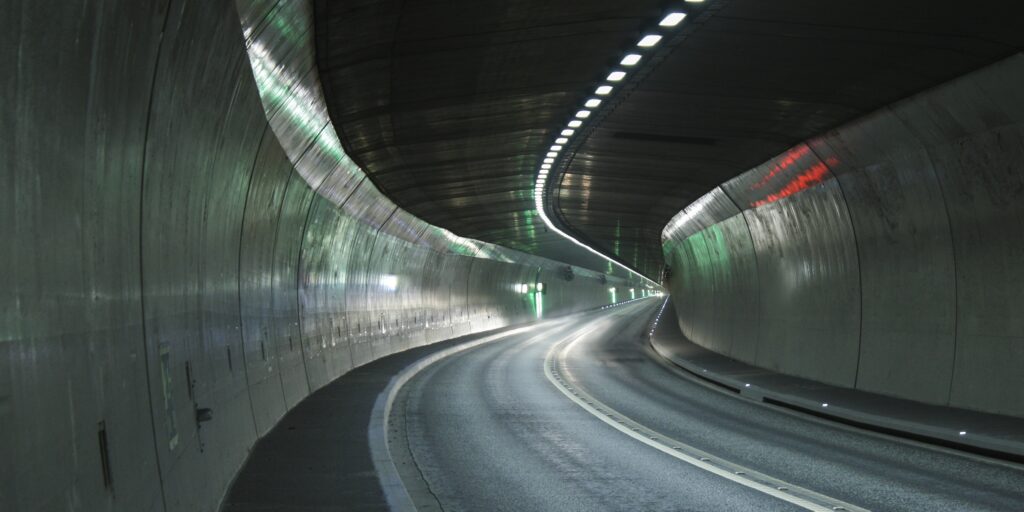
Tunnel Waterproofing: An Ongoing Challenge
For over 80 years, tunnel waterproofing has been carried out in much the same way in most parts of the world. However, although the process has become standardised, questions remain regarding its effectiveness and suitability for a variety of geological and climatic conditions.
Common Waterproofing Methods
The most commonly used technique for tunnel waterproofing involves the installation of a heat-sealed membrane. This system is complemented by a geotextil and longitudinal drainage located on both sides of the tunnel base. Additionally, concrete is used, which can be either sprayed or made of precast segments assembled inside the tunnel. Broadly speaking, this method is presented as a comprehensive solution to guarantee watertightness.
However, the effectiveness of this system depends on several factors, such as the composition of the surrounding ground, the depth of the tunnel, and its intended use. These elements determine the required level of waterproofing, which can range from basic levels to more rigorous specifications, commonly represented as grades from 1 to 7.
Challenges of Waterproofing
Despite the prevalence of this method, it is not without its problems. Waterproofing membranes can fail for various reasons, such as installation defects, extreme environmental conditions, or wear and tear over time. Likewise, the watertightness of the concrete can be compromised by water infiltration, leading to the corrosion of the steel reinforcement. This is a critical issue, as the oxidation of the reinforcement can severely affect the structural integrity of the tunnel.
Consequently, complementary solutions have been developed. One of these involves lining the tunnel interior with composite panels, a material that allows water to be diverted to the sides. The drainage system then evacuates the water, preventing it from affecting road traffic and tunnel safety. While this technique is useful, it also raises questions regarding the management of water that seeps through the concrete.
Reflections on the Efficiency of Methods
The choice of waterproofing systems based on PVC membranes or the use of composite liners raises several critical questions. Are they really the best option for all situations? Do they offer a cost-effective, quick and easy-to-repair solution? These questions are essential, particularly in a context where resources are limited and efficiency is a priority.
On the other hand, the use of additives to waterproof concrete is an alternative which, although it does not always guarantee the desired result, can be effective in specific conditions. Waterproofing mortars, which work by counter-pressure and adhere to the substrate, could offer a viable solution and, furthermore, are not particularly expensive. However, their application can be slower and require adequate curing time.
Proposed Solution: 100% Waterproof Concrete
In the face of these challenges, a crucial question arises: wouldn’t it be more logical to design a 100% waterproof concrete? This strategy could not only prevent failures in waterproofing membranes but also eliminate the need for costly and potentially ineffective complementary methods.
Fortunately, nanotechnology and advancements in construction materials are opening new doors. The molecular restructuring of concrete offers the possibility of achieving the desired waterproofing while also providing enhanced properties. For instance, concrete treated with nanoparticles can exhibit greater compressive strength, a reduction in carbonation, and the ability to self-heal cracks in the presence of water. These characteristics would not only improve the material’s durability but also increase the safety and functionality of tunnels.
Conclusion
Tunnel waterproofing remains a complex and constantly evolving issue. As technology advances, the exploration of new materials and methods becomes a necessity. Continuous research and innovation are fundamental to addressing existing challenges, optimising safety, and ensuring more durable and efficient structures.
With the integration of emerging technologies, we can aspire to a future where tunnel waterproofing is not only effective but also sustainable and economically viable. The search for innovative solutions is essential to overcome the limitations of traditional methods and ensure safety in underground transport.